Productions have a lot of moving parts. Locations, travel, weather, scheduling, shoot days and post-production can all affect the timeline and budget before cameras even start rolling.
Virtual production gives brands and creative teams another way to approach those challenges.
By combining physical production with real-time virtual environments displayed on an LED wall, virtual production can bring more of the production process into one controlled space — while giving clients and crews the ability to see and adjust their environment in real time.
According to Tyler, Virtual Production Supervisor at TRG Multimedia, some of the biggest advantages aren't necessarily about the technology itself. They're about what the technology allows a production to do differently.
Spend Less Time Moving and More Time Creating
One of the clearest opportunities for efficiency comes from reducing the need to move an entire production between locations.
“Moving an entire crew from one location to another — just not having that alone can really compress the amount of shoot days and the timeline that you ultimately need,” Tyler explains.
Virtual production can bring different environments to the stage rather than requiring the production to travel to each one. That can also help minimize logistical variables like crew travel and weather.
For marketing teams, those efficiencies can have a larger impact.
As Tyler puts it, virtual production “allows them to do more and go further with their existing budget.”
Make Decisions Earlier
Virtual production doesn't necessarily eliminate work. In many cases, it shifts that work earlier in the process.
Environments and creative decisions need to be developed, reviewed and tested before shoot day. That requires more intentional pre-production, but it can also prevent decisions from lingering later in post.
“VP actually kind of forces those decisions to happen earlier,” Tyler says.
That means the client, creative team, CG artists and production crew can align on more of the final look before and during the shoot rather than waiting to see how everything comes together afterward.
In a best-case scenario, Tyler says the client can leave shoot day with footage that is largely complete aside from elements like the final color grade.
Get Feedback in Real Time
Another major difference is the speed of creative feedback.
With a traditional post-production or CG workflow, there can be a significant gap between requesting a change and seeing the result. Within a real-time Unreal Engine environment, many changes can happen almost instantaneously.
That changes the experience for both the client and crew.
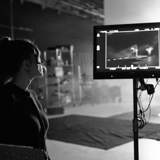
Instead of imagining what something might look like after post-production, teams can see what's happening on set, make decisions, and respond accordingly.
As Tyler explains, even when two workflows might ultimately produce similar results, “it’s how you get there that is really the defining difference.”
Capture More Content While Everything Is Set
Efficiency can also mean getting more from the production you've already built.
For example, a primary video team could complete its shoot before handing the stage over to a social team. The environment and lighting are already in place, and because the production isn't dependent on natural daylight, teams have more flexibility to continue capturing content.
“You can get a bunch of different tiers of content all at the same time,” Tyler says.
For brands producing content across campaigns, websites, and social platforms, that opens up opportunities to think beyond a single deliverable when planning a shoot.
Virtual Production as Part of the Bigger Picture
Virtual production isn't necessarily the right answer for every production, nor does it need to replace every traditional production or post-production technique.
Instead, it's another tool that can be integrated into a larger workflow.
When the project is a good fit, its biggest advantage may be less about the spectacle of an LED wall and more about creating a production process where locations, teams, technology and decision-making can work together more efficiently.
At TRG Multimedia, our virtual production, CGI, video and production teams work together under one roof to determine how these tools can best support each project.
Interested in exploring whether virtual production makes sense for your next project? Get in touch with our team to start the conversation.