Virtual production allows brands to film different seasonal environments during one studio production by changing the backgrounds displayed on an LED wall. Combined with physical scenery and repeatable camera movements, it can also help connect those environments into a continuous-looking sequence.
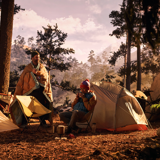
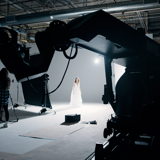
At TRG, a camping spec shoot put that approach into practice. Our team combined virtual production, MILO motion control, custom scenery, and digital environments to move through changing seasons without heading into the mountains.
We sat down with Tyler Spicher, TRG’s virtual production supervisor, and Tim Smith, our motion control operator, to explain how it came together.
How can you film different seasons without waiting for the weather?
An LED volume wall lets a production team change the environment behind a scene while filming inside the studio. That makes it possible to capture seasonal changes without returning to an outdoor location throughout the year.
For the camping shoot, the team repeated a camera movement across multiple days, varying the backgrounds and seasonal environments.
“The background kept changing and the seasons kept changing,” Tyler explains. “We were able to kind of just then splice those together in the edit to have a seamless single camera move.”
The approach supported a creative idea that would have been much more complicated to coordinate outdoors: showing the passage of seasons through connected camera movement.
Repeatable camera moves make seasonal transitions possible
Motion control allows the camera to repeat a programmed movement with precise timing. That consistency gives editors matching footage to work with when connecting scenes filmed with different backgrounds or set arrangements.
TRG’s MILO robot controls the camera’s movement through software called Flare. The team can program a move, repeat it, and fine-tune its timing as the shot develops.
“Match cuts are very easy with the Milo because it is the same exact frame-accurate movement every single time,” Tim says.
For a sequence built around changing scenery, that repeatability helps keep the camera movement consistent while the world around it changes.
Physical scenery brings the virtual environment together
Physical foreground elements help connect the action in front of the camera with the environment on the LED wall. The background is one part of the scene; the surrounding scenery also needs to feel convincing. For the camping spec shoot, TRG’s art department created tree trunks, giant boulders, and a foreground environment that worked with the virtual landscape.
“Having those foreground elements just really sets the scene and makes what’s on the wall feel that much more realistic,” Tim explains.
The connection went a step further. The team scanned physical rocks and placed digital versions in the Unreal Engine scene, where they could be scaled and rotated to extend the environment.
That gave the physical set and virtual background shared visual details, helping them feel like parts of the same place.
How do you check that the shots will connect in the edit?
Repeating the camera move is only part of creating a successful transition. Objects within each scene also need to line up to support the cut.
Tim describes using playback overlays to compare a previous take with the current setup. Viewing both together helps the team spot awkward overlaps and adjust the placement of scenery or products before continuing.
“We can do a 50% overlay on the monitor to watch the previous take, watch the current setup, and see how everything’s fitting together,” he explains.
That gives the team a practical way to evaluate the transition during production, while adjustments can still happen on set.
When should brands consider this approach for seasonal content?
This approach is worth exploring when a concept depends on changes in environment, controlled camera movement, or transitions between scenes.
The camping spec shoot brought several capabilities together: physical set creation, virtual environments, motion control, and planning for the edit. Each contributed to the same creative goal.
For brands planning seasonal campaigns, that opens up a useful question early in production: could the environments come to the shoot?
At TRG, our teams can help evaluate that possibility and determine how virtual production, physical scenery, and motion control could support the idea.